It's so true in many situations, isn't it, that a little can go a long way.
Take the weekend before last. I was home alone - unplanned; O.K. was supposed to be with me all weekend. But he had been struggling with a nasty cold all week already (of course still going to work everyday, plus having extra band practice in preparation for the annual concert), and by Friday evening, it was clear that the reasonable thing to do would be for him to stay home and get some rest on the weekend, not face a 150 km drive on potentially snowy roads just to see me and then back on Sunday night with probably more snow.
Of course I missed seeing him, but a visit to the Christmas Market with my sister cheered me up, as did the sight of a light dusting of snow on Saturday morning:
On the Sunday, it snowed a lot more, and I only left the house to go to the gym, which is really just down the road from where I live.
In the afternoon, I dediced to do something about the somewhat less than happy mood in my house (long story - nothing to do with me, but it does affect me nonetheless). It being the 2nd Advent Sunday, I prepared three plates of chocolate-covered Lebkuchen (a typical German Christmas thing), put a tea light in the middle of each and took them round to the three other flats in my house; the attic one, the ground floor and the (very new) cellar mini-flat that has recently been created and is rented by a young Syrian refugee who is a trainee at one of the biggest factories in my town. I'd not met him yet, so I thought this was a good occasion to introduce myself to my new neighbour.
I took the plates round and they were much appreciated. Everybody wanted me to come in and stay for a cup of tea or coffee, but I declined; all I wanted was to spread a little cheer, and I think I managed that.
The following week (last week) was once again very busy work-wise. Ever since I moved into this flat in 2003, I have never done so little in terms of Christmas decoration. A big box full still sits in my cellar, but even though I very much feel "christmassy" in my heart and mind, I somehow don't feel like bringing the box upstairs and decorate.
Instead, this year I rely on the many beautiful Christmas cards I keep receiving - the minority from Germany, the majority from friends and family in Yorkshire and from my blogging friends. Thank you all so much - you know who you are!
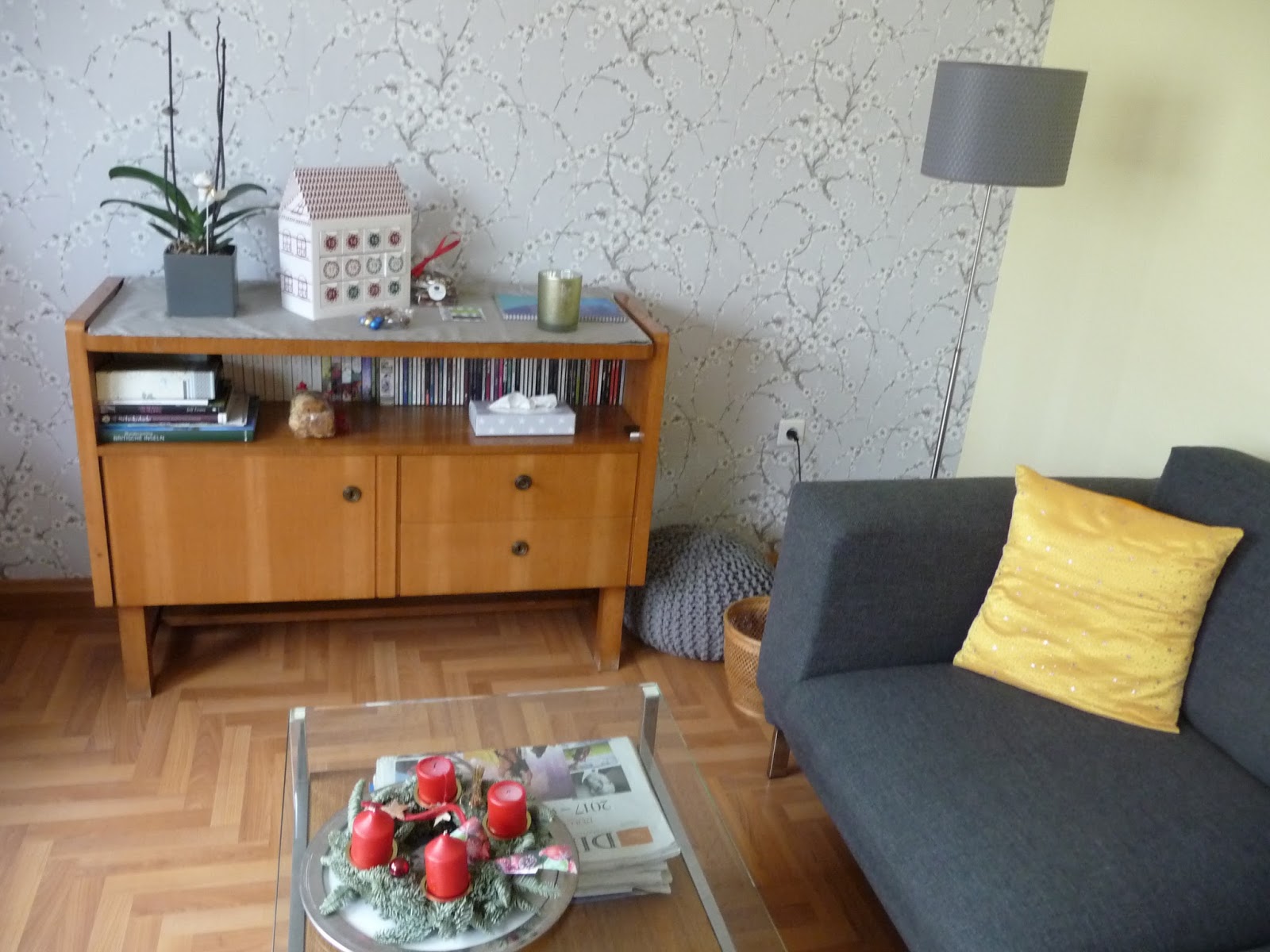
They do give the living room a festive mood, don't they? Also, today I received my presents from England, which I will open on the morning of the 25th, before getting on a train to O.K.'s. I have put them on the TV table next to my Midsomer Murders Christmas special DVD, which my sister-in-law sent me some years ago.
On the coffee table sits the advent wreath my Mum and Dad gave me. You can see only two candles are lit; I was home last night (on the 3rd Advent Sunday) at 10:30 pm and went to bed almost immediately without lighting any candles.
The yellow pillow case is a gift from my sister. You probably can't see it very well in the picture, but it is covered in tiny shiny stars - very festive!
Above the settee is the only Christmas ornament I have brought up from the cellar, with its brother in the bedroom.
It has been snowing this morning, making me glad I was working from home for a few hours before going to my customer where I have a desk on the 9th floor. Seeing the snow, receiving cards and parcels, knowing I have all my presents ready (they only need wrapping), the concert of O.K.'s village band last Saturday night and having coffee and more Lebkuchen with his family on Sunday afternoon - it all adds to the Christmas mood I'm in.
And then there was the funny little conversation I had with the postie just an hour ago. Lucky I was home when he rang, as he brought the aforementioned presents from England and some more cards! When I saw how much he had for me, I said "So much!" to which he replied with a smile: "Well, if you order so many things..."
I said that I had ordered nothing, and that these were all presents for me, since I'd been good all year and we all know that Santa brings nice things to the good ones. I added that I was sure he'd been good, too, and would have lovely presents for Christmas. He looked at me for a moment through his slightly steamed-up specs (it was cold outside, and much warmer in my stair case, where we were standing), then broke into a wide grin and said "You're right!" before he wished me a good day and went back down the stairs. After he shut the door from outside, I still heard him chuckle.
As I said, a little can go a long way.
Labels
- Book and film reviews (514)
- Daily Life (590)
- Family (271)
- Fashion for the shallow-minded (89)
- Guest Posts (41)
- Inside My Mind (111)
- Ludwigsburg (185)
- Miscellaneous (355)
- Recipes (61)
- Short Stories (17)
- Special Occasions (310)
- Travelling (482)
Monday, 18 December 2017
Sunday, 10 December 2017
Going Underground
A few months ago (in September, to be more precise), I was invited to come along for O.K.'s village band's annual day out. We did not travel far, only from the village to the nearby city of Offenburg, where we were booked for a guided tour underground.
Underground in this case meant visiting the cellars of various historical buildings in the town center, from medieval times to more recent ones. There were some surprises for us in store, and I could have taken many more pictures than I did, but you can imagine the lighting was not always favourable and also the limited space often meant I could not get a picture without some one or other from our group in it.
The first cellar we entered was a very large room, once used for storage. Nowadays, it contains a lapidarium, not unlike the one in Ludwigsburg's palace I showed you here.
In this case, the statues were not just taken from one building, but came from various sources: some from churches, others from the residential buildings of rich and important towns people, and one from a fountain. Some of them have been replaced at their original locations with replicas, while others are from buildings that do not exist any more.
These first three pictures are of a group of Gothic statues taken from a chapel. They represent the scene in the garden of Gethsemane, where Jesus retreated for prayer the night before his arrest. He asked his disciples to stay awake with him, but one by one, they fell asleep.
I wonder whether you can identify them; usually, the 12 apostles are represented in art each with their typical attributes.
I am not sure where this broken unicorn once was, but the peasant girl with the fruit was once adorning the top of a Baroque garden wall, if I remember correctly:
The impressively muscular long-haired guy is Neptune. A replica of this original statue stands on top of Neptune Fountain in Offenburg's town centre.
A dark passage leads from the lapidarium to smaller rooms, where examples of the cellar's former purpose can be seen:
Back outside, it was still daylight :-)
A private house was the next stop of our tour. The owners kindly allow guided tours into their cellar every now and then. Some years ago, while some renovation work was going on, a deep well was discovered, plus a tunnel leading out of the cellar to a place below the city wall. Both were examined by a team of archaeologists, and the well is definitely medieval. The secret tunnel is thought to be of more recent times, probably built during WWII. It can not be entered, as it is too dangerous (and parts of it are still filled with rubble from when it caved in at one time), but it is known where it ends, and you can view the first part which is lit up for us to have a look. "Fluchttunnel" (as seen on the sign) means flight tunnel.
We visited another cellar, but I did not take any pictures there. Our last stop was another place dating back several centuries. At one time, it was accessible from a square in the town centre, with no building on top. Then, after WWI, a war memorial was built in the middle of the square, right above the cellar, and gradually, its existence was forgotten. Much later, a tiny kiosk/café was installed on the square, and when public toilets were built underground for convenience, the old cellar was discovered. It is strange to see these old steps end right at the ceiling, knowing that at one time, countless feet went up and down there, carrying goods down to store or up to use them.
Now every time I am in Offenburg's town centre and come past the war memorial, I think of the cellar I know is underneath.
It was an interesting afternoon; I love such glimpses behind the scenes, seeing things you normally can not see in places that are normally not accessible to the public.
Tuesday, 5 December 2017
Something About Food
Food is so much more than just sustenance, isn't it? We share it with friends and family, deals are made and sealed over "business lunches", state affairs are conducted and concluded at state dinners; food can comfort us, warm us, or refresh us - in short, it can fill so many needs and not just our stomachs.
During the week, I hardly ever cook at home. I am on my own, and after coffee and muesli in the morning, I have a cooked lunch at the canteen of whichever customer I happen to work for that day. Two hot meals a day are a bit much, I find, and so at night, I often just have a bowl of salad - and plenty of chocolate afterwards.
My salads usually consist of whatever needs using up. I often put in bits of cheese, a handful of a fruit & nuts mix (or just nuts), a diced apple, fresh pepper (yellow being my favourite) and so on. Here is an example, made some time last month but very typical:
When I am at O.K.'s or he is at my place for the weekend, sometimes we cook together (such as the filled pumpkins we made a while ago), sometimes we eat out. One weekend in November, we went shopping in Stuttgart together. The shop we visited is rather expensive, and for us, the pleasure is as much in just looking at things we know we will never buy as the actual buying of things we like, need (or think we need) or want as gifts for someone.
They also run a restaurant you walk through when entering the shop. With their own bakery attached, they offer really, REALLY nice bread. So far, when we've been there, we have chosen from their bread menue. Here is what we had the other day:
Other places where we eat more or less regularly are at our respective parents'. In November, my Mum made her traditional roast goose with stuffing for a family dinner. It was as delicious as it looks!
Here's to great food - and to all those who prepare it for us!
During the week, I hardly ever cook at home. I am on my own, and after coffee and muesli in the morning, I have a cooked lunch at the canteen of whichever customer I happen to work for that day. Two hot meals a day are a bit much, I find, and so at night, I often just have a bowl of salad - and plenty of chocolate afterwards.
My salads usually consist of whatever needs using up. I often put in bits of cheese, a handful of a fruit & nuts mix (or just nuts), a diced apple, fresh pepper (yellow being my favourite) and so on. Here is an example, made some time last month but very typical:
When I am at O.K.'s or he is at my place for the weekend, sometimes we cook together (such as the filled pumpkins we made a while ago), sometimes we eat out. One weekend in November, we went shopping in Stuttgart together. The shop we visited is rather expensive, and for us, the pleasure is as much in just looking at things we know we will never buy as the actual buying of things we like, need (or think we need) or want as gifts for someone.
They also run a restaurant you walk through when entering the shop. With their own bakery attached, they offer really, REALLY nice bread. So far, when we've been there, we have chosen from their bread menue. Here is what we had the other day:
![]() |
| Goat cheese, caramelised nuts and honey on a buttered slice of rustic bread |
![]() |
| Grana padano, anchovies and rucola; freshly made fruit juice in the glass |
![]() |
| Tomato soup |
Other places where we eat more or less regularly are at our respective parents'. In November, my Mum made her traditional roast goose with stuffing for a family dinner. It was as delicious as it looks!
Here's to great food - and to all those who prepare it for us!
Labels:
Daily Life,
Family,
Miscellaneous,
Recipes,
Special Occasions
Saturday, 2 December 2017
Read in 2017 - 38: Dawn
"Dawn" by Eleanor H. PorterThis story, published in 1919 and set in the years before and during WWI, is not only well written and of just the right length to keep you interested. It was also an especially poignant read for me, as you will soon understand.
After he has lost his wife and two little boys to (a never specified) illness, Daniel Burton is left to raise his son Keith alone, with the help of one faithful servant who does all their cooking, cleaning and washing. Mr. Burton is an artist - he paints pictures, but they do not sell well, and so the small family lives in their big old house in a state of noble poverty and shabbiness. Mr. Burton loves his son very much and has high hopes that one day the boy will rise above their current precarious state, becoming a great artist and achieving all that his father and his two dead brothers could never do.
In his early teens, Keith's eyes deteriorate to the point of blindness. A long, hard struggle (involving money and pride) follows; several operations and months of training and learning for Keith mean he is away from home for years.
When he comes back, he is a young man, and his life - and that of his father - has changed forever.
The faithful maid, Susan, plays an important role - maybe the most important of all -, as do the neighbours' son who is more or less Keith's age, and Dorothy, a girl Keith has known since she was wearing pigtails.
Money is crucial, but even more so are faith (in one's own abilities as well as in God), trust, friendship, love and humour. The impending - and then ongoing - war is a backdrop without which a lot of what happens in the story would not be happening.
Characters and places are well described, although sometimes conversations run a little long when it would not be strictly necessary.
I won't tell you anymore of the book, because I would really like you to read it for yourself.
Now, what made it such a poignant read for me? You see (!), from the beginning of this year, my left eye has gone from bad to worse. My eyes have always been "bad"; I had my first specs at the age of 7 and am rather helpless without them. But the development with my left eye means I am probably going to need surgery next year; I have regular appointments with my doctor (which I dread - not the doctor, who is a very nice lady, but the examinations).
The way Keith took a long time to realise it was his eyes that were the problem, not something else (like fog that did not seem to shift for days, or a badly printed paper), reminded me very much of how I thought for months it was my specs that were smudged, or I simply had something in my eye, or was tired from being at the computer for too many hours, and so on.
Now, I do not expect to go blind anytime soon, but I think you understand why Keith's story spoke to me more than it would have done otherwise.
I did not know the author until I read "Pollyanna" a while ago. Eleanor Emily Hodgman Porter lived from 1868 to 1920. She was trained as a singer, attending the New England Conservatory for several years. In 1892 she married and relocated to Massachusetts, where she began writing and publishing short stories and novels. While researching for this review, I found that she also wrote a novel "Keith's Dark Tower". I wonder whether it is a sequel to "Dawn"; if yes, I definitely want to read it.
(Of course I found this book for free on Amazon's kindle store.)
Friday, 1 December 2017
Winter Wonderland
Well, not quite yet. The snow we've been having for the past two days is still rather wet, and yesterday by the time I left work, it was nearly all gone because it had turned into sleety rain first and then into proper rain.
But here are, as a very quick post before I head off to work, the most recent views from my kitchen window.
Earlier this week:
Yesterday morning:
About half an hour ago this morning:
Oh, and to put you into an even more wintery-cuddly mood, here are the latest pictures from two of the kittens and their mother - you remember the story (if not, you can read it here):
Off to work now; have a good day, whatever you'll be doing!
Monday, 27 November 2017
The Palace At Dark
The beautiful palace of my home town has featured many times on my blog already. For (outside and inside) pictures and information, simply click on the label "Ludwigsburg" (red arrow in the screenshot) or type "Ludwigsburg palace" (or just "palace", or "Ludwigsburg") in the search box (blue arrow).
I've known it well from early childhood, and when I was a little girl, I often fantasised about hiding somewhere during a guided tour (the state rooms are only accessible with tours, while some others have been turned into museums where one can wander more or less freely) and then come out at night to explore the palace on my own.
What never featured in my daydreams was that a) of course my parents would never allow me to lurk behind while on a guided tour, and b) the tour guides usually unlock and lock doors for their groups at regular intervals - so my radius of exploring would have been very limited anyway, if I had managed to stay behind in the first place, which is highly unlikely.
Still, the desire to be inside those wonderful rooms after regular hours remained, and last week, that is just what we did!
My parents, my sister and I joined a special "after dark" tour. The aim was to show people what it used to be like at the time when the palace was a busy place where up to 1,800 servants worked (and most of them lived), plus the duke (and later king) with his family and guests (and their servants).
Electricity arrived at the state rooms rather late, and until today, there is no proper heating except for in office or museum rooms.
Our tour guide was an elderly gentleman, a retired electrician. He told us that from Day One of his apprenticeship in April 1953, he worked at the palace, and it has not let him go even now in his retirement. You could tell there was a man who loved his subject, and was very well able to transmit this to the group.
We walked through 28 rooms, big and small ones, servants' quarters as well as the throne rooms, all by the dim light of yellowish bulbs mimicking candle light. (No real candles were lit - too dangerous!).
Our guide explained that they knew from old documents how many candles were used on average; household accounts were meticulously kept in places like this. For everyday use, tallow candles were standard. They did not burn very brightly but were comparatively cheap and easy to come by. For festive occasions, white candles were in order. Only in churches and palaces would you find white candles, and even then, only for special occasions. They were made of a substance gained from whales, and of course there are no whales anywhere near Ludwigsburg - whale hunting was dangerous, and its products had to travel far and were very expensive accordingly.
From the old documents, they knew just how many candles were lit in, say, the stately dining room for a big dinner, and how many were allowed in the servants' quarters. In closely controlled tests, they lit exactly the number of white or tallow candles, and measured the brightness of light in each instance. Now you all know that the measure for brightness is lux.
Wikipedia (and our tour guide) tells us how many lux the average living rooms have nowadays, with our electric lamps: around 70, and 80 in an average kitchen. Offices are more or less standardly lit at 500 lux, and sales rooms at 1,000 (I am not kidding you).
Now what do you think the festive lighting at the palace managed to produce, lux-wise?
20! No more than that. And in the servants' rooms and everywhere else apart from the most important rooms? 2 (in words: two!) lux.
He showed us how little light that is by turning off most of the bulbs (which, by the way, are kitchen oven bulbs - those were the only ones matching their criteria, and they found that out after extensively testing nearly 20 different light sources). Believe me, it was VERY little light. After dark in those days, anything that involved seeing properly, such as cleaning, mending, reading, writing or needlework, simply could not be done. No wonder people went to bed early, and rose early, too, to make use of as much daylight as possible!
It was a fascinating glimpse (!) into the "good old times" (which weren't all that good, as we all know), and we enjoyed the tour very much.
My sister took the photos with her mobile phone, and I have her kind permission to show them here.
Subscribe to:
Posts (Atom)


